Death by a Thousand Cuts: Why Sampling High-Dollar Claims Fails
Sep 20, 2025

Most payment integrity strategies rely on a simple heuristic. They assume the biggest savings lie in the most expensive claims. It is standard practice for auditors to set an arbitrary threshold, perhaps $10,000 or $25,000, and review every line item above that watermark. The remaining tens of thousands of claims are subjected to random sampling or ignored entirely. On paper, this maximizes return on effort. In practice, it creates a massive blind spot that drains plan assets through high-frequency, low-severity errors. High-dollar claims carry risk, but they are rare outliers in the broader context of plan utilization. The vast majority of healthcare interactions are routine office visits, standard labs, and recurring therapies. These claims fly under the radar of threshold-based audits. Providers and billing systems understand these filters well. Consequently, systemic billing errors often cluster in the mid-range of claim values where scrutiny is minimal.
The Economics of Small Errors
Data analysis reveals that the most pervasive sources of leakage are rarely headline-grabbing surgical errors. Instead, they are subtle, repetitive coding inaccuracies that add small incremental costs to thousands of claims. Modifier errors are a prime example. They account for 22% of identified leakage. These errors occur when a provider improperly appends a code to bypass bundling edits or justify a higher reimbursement rate. A single instance might only cost the plan an extra $50 or $100. When that same logic is hard-coded into a provider's billing software and applied to every patient visit for two years, the financial impact becomes substantial. Quantity mismatches present a similar challenge. Contributing 18% to total waste, these errors often involve billing for more units of medication or service than were actually administered. A discrepancy of one or two units on a low-cost drug seems negligible during a spot check. It only becomes visible as a major loss driver when you analyze the aggregate volume across the entire plan population.
The Statistical Failure of Sampling
Random sampling offers a statistical illusion of coverage. If a specific billing error affects 2% of your claim volume, a random sample of 5% of your claims might catch a few instances. The auditor will likely flag these as isolated mistakes and recover a few hundred dollars. This approach fails to identify the systemic nature of the problem. You might correct the handful of claims in the sample, but you leave tens of thousands of dollars unrecovered in the unchecked population. Sampling treats leakage as a series of unrelated accidents rather than a pattern of operational behavior. Legacy tools that rely on these methods miss the "long tail" of leakage. They are built for a world where auditing was a manual, human-intensive process that required narrowing the field to be feasible. That constraint no longer exists.
The Necessity of 100% Auditing
Random sampling offers a statistical illusion of coverage. If a specific billing error affects 2% of your claim volume, a random sample of 5% of your claims might catch a few instances. The auditor will likely flag these as isolated mistakes and recover a few hundred dollars. This approach fails to identify the systemic nature of the problem. You might correct the handful of claims in the sample, but you leave tens of thousands of dollars unrecovered in the unchecked population. Sampling treats leakage as a series of unrelated accidents rather than a pattern of operational behavior. Legacy tools that rely on these methods miss the "long tail" of leakage. They are built for a world where auditing was a manual, human-intensive process that required narrowing the field to be feasible. That constraint no longer exists.
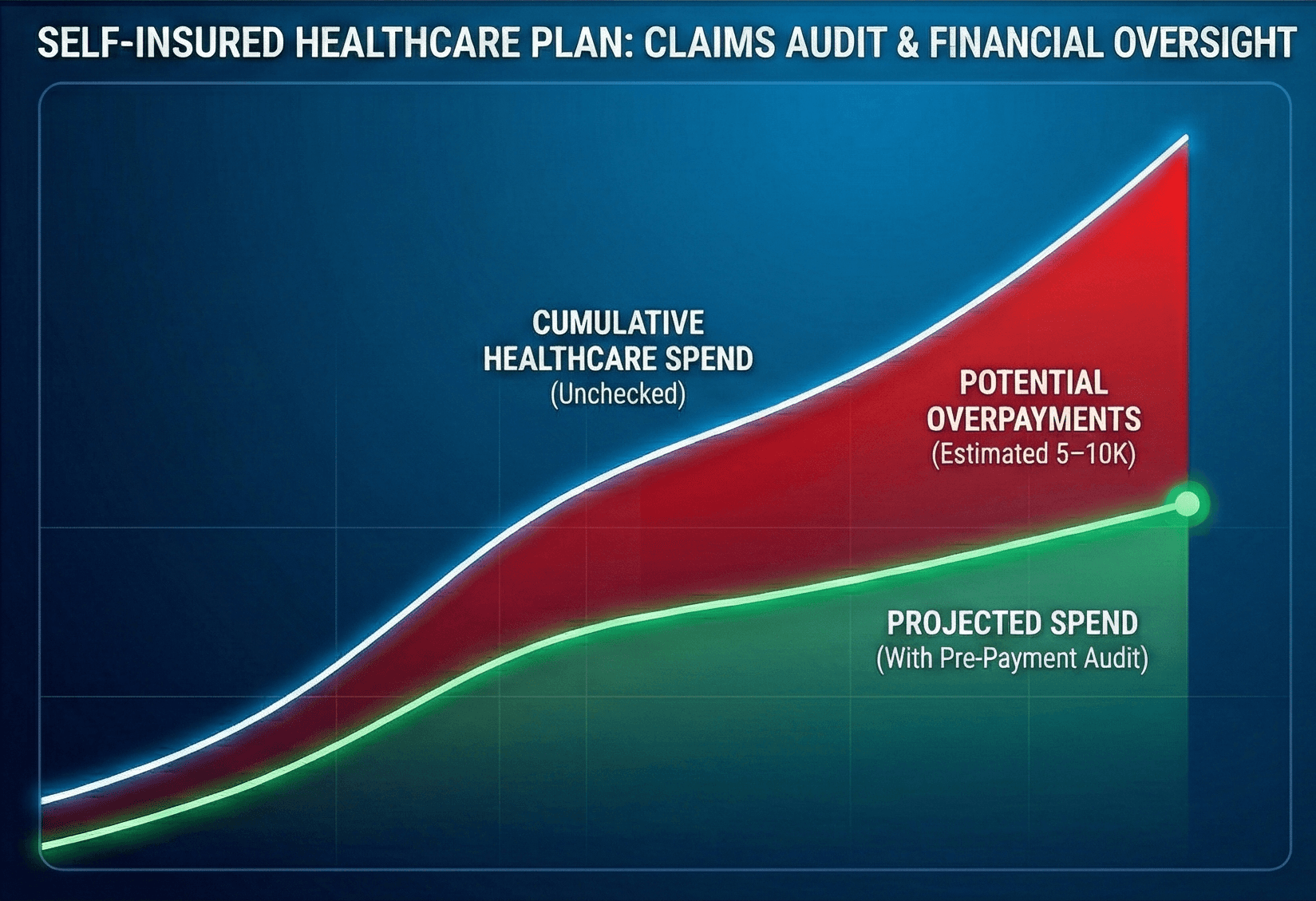

The economic barrier to full-population auditing has collapsed. Advanced machine learning models can now ingest and normalize raw claims data to review 100% of line items at the patient level. This capability allows plan sponsors to move away from the "pay and chase" model of spot-checking high-dollar claims. By analyzing the entire dataset, you detect the signal within the noise. You see that a specific provider isn't just making a mistake on one claim; they are misapplying a modifier on every single patient interaction. Modern cost containment requires a shift in perspective. The danger to your plan is not just the catastrophic outlier claim. It is the steady, silent accumulation of minor errors that slip through the net of legacy audits. Protecting your plan assets means closing the gaps where the real volume lives.
Recovery on autopilot
Dispute, track, recover, and close overpayments fast
Recovery on autopilot
Dispute, track, recover, and close overpayments fast
Recovery on autopilot
Dispute, track, recover, and close overpayments fast
Recovery on autopilot
Dispute, track, recover, and close overpayments fast
© 2025 Avelis Inc.

© 2025 Avelis Inc.

© 2025 Avelis Inc.

© 2025 Avelis Inc.